新書推薦:

《
经过检视的人生 从苏格拉底到尼采
》
售價:HK$
66.0

《
阿尔喀比亚德斯 I(柏拉图全集)
》
售價:HK$
107.8

《
百家争鸣与中华文明的哲学突破
》
售價:HK$
115.5

《
孟子学术流传与秦汉价值重构
》
售價:HK$
110.0

《
中国早期城市与文明起源 一部中国早期城市发展简史,解读城市与文明交织共生的规律
》
售價:HK$
96.8

《
只要我还在创作 角谷美智子访谈录
》
售價:HK$
74.8

《
国医大师邓铁涛 治未病从孩子抓起 中医治未病 二十四节气顺时调养 常见病预防 中医健康体检 广东科技
》
售價:HK$
54.9

《
英国都铎王朝君主形象塑造与政治文化变迁
》
售價:HK$
184.8
|
| 內容簡介: |
|
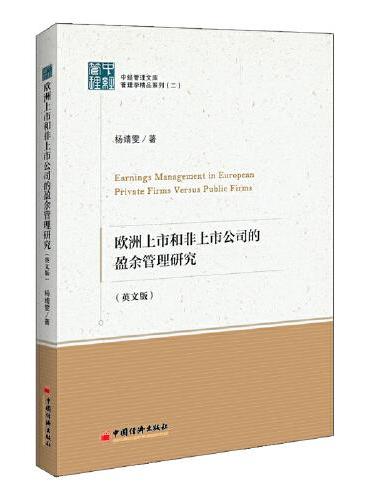
自20世纪80 年代起,盈余管理一直是会计学界研究的热点问题,但很多研究都是围绕上市公司展开。然而,仅关注上市公司,往往无法区分盈余管理基于会计的监管和资本市场压力的影响。因此,比较上市公司和非上市公司有助于评估资本市场压力对盈余管理的影响。另一方面,非上市公司作为市场经济中的重要组成部分,和上市公司在规模,所有权和内部管理上都存在着较大的差异。而这些差异也有可能造成公司参与的盈余管理的动机和程度有所不同。所以,通过对非上市公司盈余管理的研究,也能丰富人们对其财务报告质量的了解。
|
| 關於作者: |
杨婧雯,
女,1991年3月生于湖南邵阳。2010年入英国兰卡斯特斯特大学会计系读书。2013年入英国班戈大学,于2018年获得会计学博士,毕业后加入班戈大学中国校区任教。现为北京第二外国语学院商学院讲师。目前主要从事财务会计教学与会计信息质量,国际会计准则的研究工作。
|
| 目錄:
|
ContEnts
Chapter 1 Introduction
1.1 Background information and motivation
1.2 Objectives of the study
1.3 Research design
1.4 Main empirical results
1.5 Contributions
1.6 Study organisation
Chapter 2 Literature review
2.1 Introduction
2.2 Private and public firms
2.2.1 What are“private firms and public firms?”
2.2.2 The differences between private and public firms
2.2.3 How are private firms’financial reporting regulated across countries?
2.3 Earnings management
2.3.1 Concept and definitions of earnings management
2.3.2 Theoretical frameworks of earnings management
2.3.3 Measures of earnings management
2.3.4 The motivation of earnings management
2.3.5 Prior empirical evidence on earnings management of private firms versus public firms
2.3.6 The review of earnings quality
2.4 International Financial Reporting Standards (IFRS)
2.4.1 Arguments for and against IFRS adoption on earnings management
2.4.2 Empirical evidence on IFRS adoption and earnings management
2.5 Factors affecting earnings management between private and public firms
2.5.1 Country-level factors
2.5.2 Firm-level factors
Chapter 3Earnings management in European private versus public firms
3.1 Introduction
3.2 Relevant literature and development of hypotheses
3.2.1 Literature on earnings management
3.2.2 The effects of mandatory IFRS adoption on earnings management
3.2.3 Country-level factors and earnings management
3.3 Data and research methodology
3.3.1 Data collection and sample selection
3.3.2 Research methodology
3.4 Empirical results
3.4.1 Descriptive statistics
3.4.2 Univariate comparison between pre- and post-IFRS adoption
3.4.3 The influence of country-level factors
3.4.4 The effects of the financial crisis
3.5 Conclusions
Chapter 4Accrual based earnings management in European private versus public firms
4.1 Introduction
4.2 Relevant literature and development of hypotheses
4.2.1 Comparing earnings management between private and public firms
4.2.2 The effects of mandatory IFRS adoption on earnings management
4.2.3 Factors affecting differential earnings management between private and public firms
4.3 Data and research methodology
4.3.1 Data collection and sample selection
4.3.2 Research methodology
4.4 Empirical results
4.4.1 Descriptive statistics
4.4.2 Regression analysis
4.4.3 Variables that could have influenced the differential
earnings management between private and public firms
4.4.4 Additional tests
4.5 Conclusions
Chapter 5Real earnings management in European private and public firms
5.1 Introduction
5.2 Relevant literature and development of hypotheses
5.2.1 Literature on real earnings management
5.2.2 Real earnings management in private and public firms
5.2.3 IFRS adoption and earnings management
5.2.4 Factors affecting differential real earnings management between private and public firms
5.3 Data and research methodology
5.3.1 Data collection and sample selection
5.3.2 Research methodology
5.4 Empirical results
5.4.1 Descriptive statistics
5.4.2 Regression analysis
5.4.3 Additional tests
5.4.4 Analyses of incentive-based real earnings management
5.5 Conclusions
Chapter 6 Summary and conclusion
6.1 Summary of the study
6.2 Research implications
6.3 Limitations and suggestions for future research
Reference
AppendixContEnts
Chapter 1 Introduction
1.1 Background information and motivation
1.2 Objectives of the study
1.3 Research design
1.4 Main empirical results
1.5 Contributions
1.6 Study organisation
Chapter 2 Literature review
2.1 Introduction
2.2 Private and public firms
2.2.1 What are“private firms and public firms?”
2.2.2 The differences between private and public firms
2.2.3 How are private firms’financial reporting regulated across countries?
2.3 Earnings management
2.3.1 Concept and definitions of earnings management
2.3.2 Theoretical frameworks of earnings management
2.3.3 Measures of earnings management
2.3.4 The motivation of earnings management
2.3.5 Prior empirical evidence on earnings management of private firms versus public firms
2.3.6 The review of earnings quality
2.4 International Financial Reporting Standards (IFRS)
2.4.1 Arguments for and against IFRS adoption on earnings management
2.4.2 Empirical evidence on IFRS adoption and earnings management
2.5 Factors affecting earnings management between private and public firms
2.5.1 Country-level factors
2.5.2 Firm-level factors
Chapter 3Earnings management in European private versus public firms
3.1 Introduction
3.2 Relevant literature and development of hypotheses
3.2.1 Literature on earnings management
3.2.2 The effects of mandatory IFRS adoption on earnings management
3.2.3 Country-level factors and earnings management
3.3 Data and research methodology
3.3.1 Data collection and sample selection
3.3.2 Research methodology
3.4 Empirical results
3.4.1 Descriptive statistics
3.4.2 Univariate comparison between pre- and post-IFRS adoption
3.4.3 The influence of country-level factors
3.4.4 The effects of the financial crisis
3.5 Conclusions
Chapter 4Accrual based earnings management in European private versus public firms
4.1 Introduction
4.2 Relevant literature and development of hypotheses
4.2.1 Comparing earnings management between private and public firms
4.2.2 The effects of mandatory IFRS adoption on earnings management
4.2.3 Factors affecting differential earnings management between private and public firms
4.3 Data and research methodology
4.3.1 Data collection and sample selection
4.3.2 Research methodology
4.4 Empirical results
4.4.1 Descriptive statistics
4.4.2 Regression analysis
4.4.3 Variables that could have influenced the differential
earnings management between private and public firms
4.4.4 Additional tests
4.5 Conclusions
Chapter 5Real earnings management in European private and public firms
5.1 Introduction
5.2 Relevant literature and development of hypotheses
5.2.1 Literature on real earnings management
5.2.2 Real earnings management in private and public firms
5.2.3 IFRS adoption and earnings management
5.2.4 Factors affecting differential real earnings management between private and public firms
5.3 Data and research methodology
5.3.1 Data collection and sample selection
5.3.2 Research methodology
5.4 Empirical results
5.4.1 Descriptive statistics
5.4.2 Regression analysis
5.4.3 Additional tests
5.4.4 Analyses of incentive-based real earnings management
5.5 Conclusions
Chapter 6 Summary and conclusion
6.1 Summary of the study
6.2 Research implications
6.3 Limitations and suggestions for future research
Reference
Appendix
|
|

 購物車/收銀台(0) | 在線留言板
| 付款方式
| 運費計算
| 聯絡我們
| 幫助中心 |
加入書簽
購物車/收銀台(0) | 在線留言板
| 付款方式
| 運費計算
| 聯絡我們
| 幫助中心 |
加入書簽 HOME
HOME 新書上架
新書上架 暢銷書架
暢銷書架